Honey Education
Raw Honey: What’s Really Inside the Jar?
The flowers, the bees, and the natural complexity of honey.
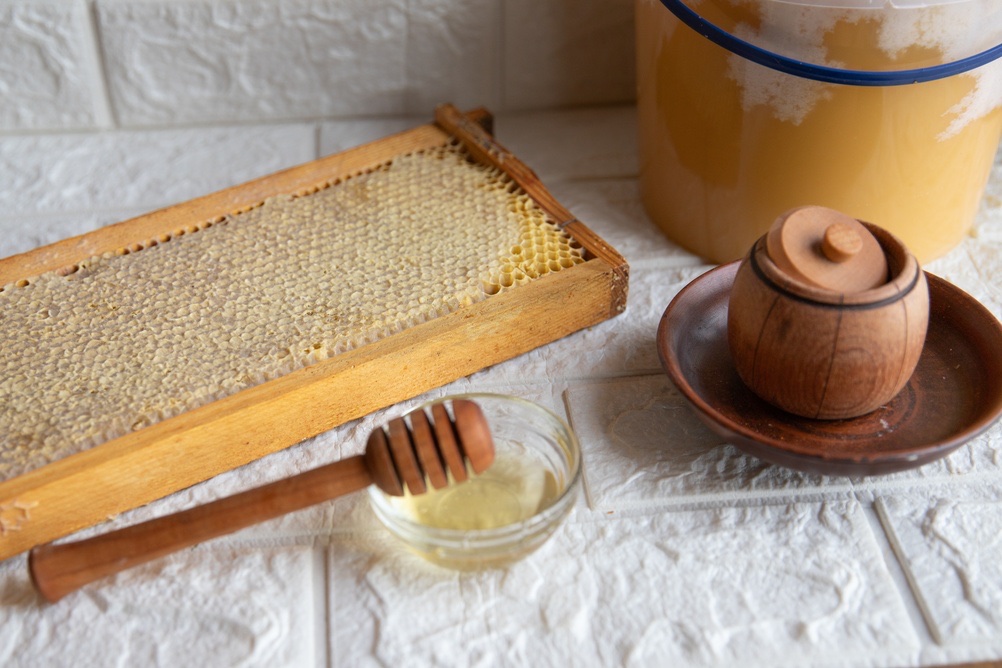
Exploring the natural complexity of honey, from the flowers our bees visit to the science behind its remarkable composition.
When you open a jar of raw honey, you’re experiencing something far more complex than a simple natural sweetener.
Honey is primarily composed of sugars and water, but it also contains a fascinating variety of naturally occurring substances that reflect the flowers, environment, and honeybees responsible for its creation.
From enzymes and organic acids to plant-derived polyphenols and traces of pollen, honey carries a chemical fingerprint of its origins.
At Odin’s Honey Haven, we think that story deserves to be told.
More Than Just Sugar
Honey’s primary sugars are fructose and glucose, but its composition extends beyond them.
Researchers have identified numerous minor components in honey, including:
- Enzymes: Naturally occurring proteins associated with nectar processing and honeybee activity.
- Polyphenols and flavonoids: Plant-derived compounds studied for their antioxidant properties. Flavonoids are one group of polyphenols.
- Organic acids: Substances that contribute to honey’s acidity and distinctive characteristics.
- Pollen particles: Naturally occurring traces that may provide information about the plants visited by honeybees.
- Aromatic compounds: The substances responsible for honey’s remarkable variety of flavors and fragrances.
- Oligosaccharides: Short chains of sugar units that researchers are investigating for possible prebiotic activity.
The amounts and types of these components vary considerably.
Not every jar contains the same concentrations, and the presence of a compound does not automatically mean that eating honey provides a clinically meaningful health benefit.
That’s part of what makes honey such an interesting subject of study.
Why Raw and Unfiltered?
At Odin’s Honey Haven, our goal is to provide honey as close to its natural harvested state as practical.
Raw honey generally refers to honey that has not undergone high-temperature processing, while unfiltered honey has not been subjected to fine filtration designed to remove very small particles. These terms do not describe one universally standardized processing method, so a producer’s handling details matter.
Honey may still be gently strained to remove larger pieces of wax and other debris.
These distinctions matter because processing conditions can influence honey’s natural composition.
Heat exposure can affect certain enzymes and heat-sensitive compounds. Fine filtration can reduce naturally occurring pollen particles.
But it’s important to recognize that processing effects vary, and raw honey is not automatically superior in every nutritional or medical respect.
For us, choosing raw and unfiltered honey is first and foremost about preserving the character, flavor, and individuality of the harvest. Final processing descriptions will accompany our confirmed products.
What Does Scientific Research Tell Us?
Honey has attracted significant scientific interest.
Researchers have investigated its chemical composition, antioxidant activity, potential effects on metabolic health, and several medical applications.
One particularly interesting systematic review and meta-analysis was first published online in 2022 in Nutrition Reviews.
The researchers examined 18 controlled feeding trials involving 1,105 participants. Pooled results suggested small changes in fasting glucose and several blood lipid measurements. Evidence for most of these outcomes was rated low certainty; the increase in HDL cholesterol was supported by higher-certainty evidence.
Some subgroup findings favored raw honey and certain floral varieties. Those findings need confirmation and do not establish that raw honey is medically superior.
These studies do not show that eating honey prevents or treats diabetes, heart disease, or other medical conditions. Honey remains a concentrated source of dietary sugars and should be enjoyed in appropriate portions.
What About Honey’s Other Studied Properties?
A Cochrane review found that honey may provide short-term relief of acute cough in children aged one year and older, with results and certainty varying by comparison. Many studies lasted only one night, so the findings should not be extended to ongoing or unexplained cough.
Separately, specially prepared medical-grade honey dressings have been investigated for wound management. Evidence varies by wound type, and the Cochrane review did not support broad conclusions for all wounds.
These are different applications involving different products and circumstances.
Researchers are also studying honey’s oligosaccharides and other compounds for potential effects on intestinal microorganisms.
That field remains developing, and laboratory findings should not be confused with proven clinical benefits from eating honey.
Every Harvest Has Its Own Character
Perhaps the most fascinating thing about honey is that its composition changes with its origins.
A light spring honey may have a delicate floral aroma and gentle sweetness.
A darker late-season honey may offer richer, more robust flavors.
Differences in floral sources, growing conditions, weather, and seasonal nectar availability all contribute to these variations. Color and flavor are not determined by the calendar alone.
That’s why we believe the character of local honey deserves appreciation. Read What Does “Local Honey” Really Mean? for more about the landscape behind a harvest.
Rather than trying to make every harvest taste identical, we want our customers to experience what the bees and Pennsylvania’s landscape have produced.
Curiosity, Honesty, and Respect for the Bees
At Odin’s Honey Haven, we appreciate the scientific research surrounding honey.
We also believe in being careful about what that research actually demonstrates.
Promising findings should inspire curiosity, not unsupported medical promises.
Our honey is intended as food, not as a treatment for disease. We’re preparing for commercial production in 2027; availability and final product descriptions will be announced when confirmed.
What we can promise is our commitment to responsible beekeeping, careful handling, honest information, and honey that reflects the flowers and seasons of Pennsylvania.
Learn more about our apiaries and colony care and explore our planned honey offerings.
Local Bees. Local Honey. Naturally Remarkable.
Further Reading
- Effect of honey on cardiometabolic risk factors: a systematic review and meta-analysis — Nutrition Reviews, first published online in 2022. PubMed record.
- Honey for acute cough in children — Cochrane systematic review, 2018. Plain-language summary.
- Honey as a topical treatment for wounds — Cochrane systematic review, 2015.
- Honey: Chemical composition, stability and authenticity — review of honey’s components and their stability.
- The Potential of Honey as a Prebiotic Food to Re-engineer the Gut Microbiome Toward a Healthy State — review of an emerging field, 2022.
- University of Arkansas Extension: All About Honey — straining, filtration, heating, and crystallization.
Let’s begin a conversation.
Local relationships are at the heart of what we’re building.